Monday, November 29, 2010

Orbs

Recently the kids (well, they're grown but will always be "The Kids") visited during the Thanksgiving weekend. We had occasion to enjoy an unusually balmy day sitting on the deck, enjoying conversation surrounded by my dogs. Several photos of Boris (my eldest dog) were taken, along with the rest of the family. Interestingly, a number of the photos of Boris had a blue orb which showed up only in his photos. No one else had blue orbs -- or any orbs for that matter. There was no dust on the camera lens, and no light leak or reflection. And just Boris had an orb. The rest of us were orb-less.

I have looked up "blue orbs" on the Internet (yes, of course, the apotheosis and repository of absolute Truth) and have discovered blue orbs to mean: " ... an indication of angels being around you, especially Archangel Michael as he resonates with the color blue." I also discovered different colors of blue mean different things: light blue means tranquility and pilot light blue means shielding. (Who in heck knows what 'pilot light blue' is. And who knows who decided what colors mean what?)

Of course, there is no science to this. But it's interesting.

In reading about the Archangel Michael, I discovered he's mentioned in Jewish, Christian, and Islamic texts. (Who knew?) And considered, among other things, to be the "field commander of the Army of God." (Thank you Wikipedia.) (OK, is it just me or does the idea of God having an Army sound just way too bizarre, nasty, and hateful? Must be the God of the Old Testament, that vengeful, spiteful, very human-like God, since we 'know' the God of the New Testament is a loving God. Not sure how Archangel Michael ranks in the Islamic text.)

Later (again in Wikipedia) I learn the name Mike (if he's visiting my dog, we're on a first name basis) "in Hebrew ... means 'who is like God' [by the way, that's a question, Christian friends, not a statement], which in Talmudic tradition is interpreted as a rhetorical question: "Who is like God?" (which expects an answer in the negative) to imply that no one is like God. In this way, Michael is seen as a symbol of humility before God." I like this explanation much better. My dogs would certainly be humble before God, if there is one. After all, dogs are named after God, only backwards.

I'm not sure how to interpret the presence of an orb that means both tranquility and shielding, but I like to think my dog will have both as he moves through his later years. Nor am I sure what the presence of these orbs means to my aging dog. Are they the spirit one of my other dogs? Tasha, perhaps, my beautiful German Shepherd who was Queen of the house, or maybe Linga, whom Boris loved without measure.

I just think it's interesting that my dog had blue orbs when no one else did. Are they dust motes? Let's not spoil it and say they are. Let's just enjoy the fact that my boy Boris is unique and the Universe recognizes this uniqueness and sent him some angelic blue orbs to bring him tranquility in his old age.

I wouldn't mind a blue orb myself, thank you.

Wednesday, March 24, 2010

The Palmer Method

I am personally partial to chocolate Easter Bunnies -- especially the bunnies manufactured by the Palmer candy company. Those named Popper and Sunny, Lil' Hopper and Baby Binks I count among my favorites. These Easter treats are hollow and somewhat fragile and must be eaten with extreme care, especially when wolfing down one or two while driving out of the parking lot of Eckerd’s. It is here where I buy my Palmer bunnies by the dozens -- ostensibly for grand children, nieces, nephews and favored neighborhood children. One learns early that counter staff in drug stores are prone to judgmental expressions of disdain if they suspect adults of buying Easter candy for themselves. So, to avoid such negative profiling, I have learned to fabricate elaborate stories about treating neighborhood urchins to Easter goodies or giving young relatives generous Easter gifts. Of course, I have no nieces or nephews, I care naught for the neighborhood children and my grand children live 700 miles away. Nor would I ever consider sharing my chocolate bunnies with any of them, even if they lived next door. Let them get their own bunnies. After all, they're children. Someone is bound to buy them chocolate bunnies for Easter. Adults have to forage for these treats on their own.

Despite the fact that the quality of Palmer chocolate is anything but gourmet, the company nevertheless goes to remarkable lengths with the packaging and preserving of their hollow bunny treats. Not only have they found it necessary to wrap these confections of little or no know nutritional value in gaily colored foil, the visage of the characteristically demented holiday hare, complete with toothy smile and gaudy bow tie or ribbon, (depending on its sex), emblazoned on the shiny surface. But, (in all likelihood because these bunnies are hollow), Palmer has also decided, in order that the chocolate not get crushed beyond recognition before being eaten and therefore rendered unsellable, (as pulverized chocolate bunny parts do not seem that attractive to the average consumer), each bunny must also be carefully cradled by its ears and feet between several fiercely inviolable layers of festively colored cardboard, and then shrink-wrapped in remarkably impenetrable plastic. While this certainly makes wresting the confection from its prison nearly impossible while driving, one has to admire the construction of each little package. Not only is each wrapper within a wrapper within yet another wrapper an unequivocal burden on the long-suffering ecology of burgeoning landfills nationwide, but this process of multiple packaging yields a product that doubtlessly has a shelf life akin to that of plutonium, making the products that don't sell one Easter available the next, and the next, and the next, until the treats are either purchased or disintegrate completely in their foil and cardboard armor. Not surprisingly, one never finds an expiration date on holiday candy of any kind. Easter bunnies are no exception.

Because of the nature of the Palmer bunny wrapping method, accessing the confection while operating a moving vehicle is not advisable. This maneuver is analogous to dialing a mobile phone while driving one's vehicle on a California Interstate during rush hour. Trying to unwrap a Palmer bunny while driving should no doubt be a criminal offense, but I have found that it is virtually impossible to resist eating at least one bunny long before ever arriving home. Temptation is too great. Of course, the inevitable epic sugar rush is also a dangerous side-effect of flagrant bunny consumption, so caution is advised here as well. Amateur chocolate consumers are advised against mixing copious amounts of Easter confections with driving. I suggest finding a diabetic as designated driver.

Yet, to satisfy my felonious lust for a Palmer bunny or two while still remaining relatively safe in my moving vehicle I have devised what I have come to call the Palmer Method. (This is not to be confused with the original Palmer Method of penmanship, now sadly long abandoned, by which young children were taught to write legibly.) My Palmer method, by the way, also works while sitting in a revolving desk chair in front of a computer screen, or sneaking bits of bunny while on the run between classes, or surreptitiously consuming copious bunny parts before others discover chocolate is nearby. But the focus of this discussion remains on safely consuming while driving.

The most difficult part of the process, as I have previously suggested, is accessing the confection in the first place. Palmer does not make this easy for consumers, whether they are moving or remaining stationary. Extricating the foil-wrapped rabbit from its hermetic captivity is much like successfully negotiating a breech birth. It takes a gentle and patient hand to release the bunny from the confines of its cardboard bondage without damaging an ear or caving in a rib. While maintaining the integrity of the bunny is not necessarily requisite to its enjoyment, if one is to avoid losing any fragment or shard of chocolate while driving distractedly, one should endeavor to keep the bunny's body intact as long as physically possible. One should especially strive for this while driving as it is difficult to fish for lost crumbs of chocolate from beneath one's bucket seat or from between one's legs while still maintaining reasonable control of the car and avoiding being gawked at by fellow drivers, as others on the road are wont to draw unusual and often lewd conclusions if they see a driver's hand frequently disappearing into his lap, regardless the reason.

The first thing one must do to release the foil-clad bunny is to puncture the plastic shrink wrap. This can be accomplished without much difficulty with a pen, pencil, hairpin or other sharp object one may find in one's car. Unhappily, old drinking straws found in the neighboring seat are of little value. Tire pressure gauges are also seldom effective and are often rendered useless in the process. Sporks, those tine-spined plastic spoons one gets at fast food drive-throughs, are also relatively ineffective, as they tend to break before the wrapping does. Nor is stabbing the plastic repeatedly with the blunt end of one's finger efficacious. However, it is here where women generally have the advantage over men, as they often sport long fingernails and these domestic weapons are perfect for tearing the tenacious wrap into shreds. Even so, ladies be warned. Lee Press-On Nails have often been lost forever, ricocheting off the unforgiving plastic like so many tiddly winks, only to be buried evermore in back seat upholstery. Then again, some of these nails, when applied at just the wrong angle, have been known to move so swiftly through the plastic that they become deeply imbedded in the bunny's chocolate and foil flesh, there to protruded like the spines of a hedgehog until they can be pulled from the carcass at the next red light. So caution is advised, whatever manner is used to render the plastic gone.

With the plastic punctured, it is relatively easy to remove and can be done so if one is even remotely good at driving with one hand. The other hand can thus be employed to wrestle off the plastic wrap. If a particular wrapping proves peculiarly contrary and unyielding, one can also, as a last resort, engage one's teeth in the process, being mindful both of one's dental work and of obscuring one's view of the road by inadvertently placing the box in front of one's eyes. Caution and good judgment are advised.

With the plastic wrap now gone, it is time to extract the bunny from its cardboard host. This can also be done with one hand. Slight pressure against the cardboard, right where it grips the bunny's ears, will generally free the candy coney from bondage. Care, however, should be taken to apply pressure to the cardboard rather than the ears of the bunny itself. While the ears are the most substantial part of the entire chocolate body, they can still nevertheless be broken. And while the foil cover keeps the ears from disappearing onto the floorboards should this happen, one must consider that, immediately upon unwrapping the foil, the broken ears are at large and must be consumed altogether immediately or lost. Too, one must understand that the ears, being the most sizeable part of the confection's design, are difficult to stuff in one's mouth whole. Again, one's driving neighbors should be considered when attempting this, as it is unseemly to view another driver engaged in any sort of mouth stuffing. Good taste should always prevail when one finds oneself engaged in eating while driving. Causing neighboring drivers to gag in sympathetic reaction is not sporting.

With the bunny now safely removed intact from the cardboard, the final process of removing the foil begins. There are two schools of approach to this. One encourages careful removal of the foil design for later entertainment. These foil dressings can be saved and later made into all sorts of artistic oddments: Origami animals, garish aluminum ornaments and cheap cat toys are but a few examples. However, most consumers simply tear off the foil, throw it into the back seat and attack the chocolate bunny with rabid fervor. I generally employ the latter approach as I have found it even more difficult to create Origami swans while driving than accessing Palmer packages.

Finally, while there are any number of individual approaches to finally enjoying one's chocolate bunny, there are two generally accepted techniques used to consume the coveted prized confection: the anterior method and the posterior method. The anterior method was alluded to earlier. In this method, one eats the ears first. One can consume the entire ear mass in one bite or one can carefully nip small, delicious bits of ear at one's leisure. Either technique is acceptable. Many people employ this ear-eating method claiming that, since the rabbit can no longer hear, this method is more humane as the bunny never hears the next bite. The other, posterior method involves eating the feet, fanny and tail of the confection first. By consuming the feet first, gastronomes claim the bunny cannot escape and a leisurely repast can be enjoyed. Of course, there are those kinky mavericks who insist on crushing the bunny into small bite sized fragments or eating from the middle outwards, but, while these techniques might be fine at home, they are inadvisable while driving. For example, small bits of chocolate can be seemingly lost, only to turn up later melted to a compromising region of the seat of one's pants. So too, eating a chocolate bunny from the middle out can leave melted chocolate on one's chin and nose. While many in our culture are recognized with these distinct markings, they are not generally from chocolate nor largely considered socially appropriate. The term brown nose is seldom if ever associated with chocolate bunny eaters. So, this approach to confection consumption, with its attendant countenance, is to be avoided lest people get the wrong impression.

Chocolate Easter bunnies are a joy to eat and certainly, to me, the most festive part of the whole Easter season. While others enjoy jelly beans and creme eggs as they ponder the season of death and rebirth, I prefer resurrecting hollow Palmer bunnies from their cardboard warrens. The struggle of the hunt and the sensuous unwrapping of each little body makes the holiday a cheerful time for me; a time to reflect on just what the holiday has come to mean ... chocolate.

Sunday, February 7, 2010

Snow

A little bit of snow goes a long way here in Middle Tennessee. My friends back home in Western New York laugh when I tell them the whole state comes to a grinding halt when we have 3 inches of snow, but then, I think the whole of Tennessee has only has one snow plow, and it never shows up here.

The problem here (besides the no-show snowplow) is that the terrain in much of the eastern part of the state, and even here in Middle Tennessee, is steep and treacherous, so even when the main highways are marginally passable, the outlying roads are impossible. And forget driveways. Merely getting our cars to move a few inches was a monumental feat until I remembered an old trick and emptied half a bag of kitty litter under the wheels. Sorry Kitty, you’ll have to crap under the tires for a while.

We have an unusual kind of snow here. Not the nice powdery stuff skiers like; not even the normal snow typical of most snowy states. We have soggy snow, unusually big blobbing globs of it that plop gracelessly from the heavens, often followed by pellets of frozen rain that freeze to everything and take down huge tree limbs that snap and crack in the dead of night — the kind of splintering limbs that echo in the dark while you strain to hear if they’ve landed on anything important — like the car or the barn. And the mix of snow and frozen rain traps even the most innocent. Dog toys, forgotten on the lawn and left to fend for themselves, remain trapped in agonized contortions, alone until they thaw in the weak winter sun.

Now snow in Western New York is generally a lot different and we’re used to it. Most of the time it falls in huge, powdery flakes or delicate crystals. We don’t even stop when a foot of snow falls over night. We have all kinds of snow shovels and snow blowers, and we don our winter gear (very similar to the clothes our mothers stuffed us in as kids), pull on our buckled boots, and trudge out looking like Michelin Men. And we pride ourselves on our ability to build snow forts that last well into April.

I remember when I was in my late 20s and living in the small cottage my family owns right on Lake Erie. That was back when everyone had a cottage and no one had yet gone ego-maniacal, thinking bigger was better, building up and out so thoroughly and thoughtlessly that quaint homes grew into monolithic eyesores only someone with more money than brains could appreciate – or want.

Back then, in the 70s, all the cottages were single story. And because there were very few people who lived on the lake during the winter, most of the houses remained totally engulfed in snow – the only things peaking out were chimneys. When the winds would blow the snow off the lake, which they did with amazing ferocity, the drifts would be so high one could literally walk from rooftop to rooftop. And I often did. Like I said, I was in my 20s. Foolish. And a lightweight.

I was there in that cold little cottage during the blizzard of 1977 and remember listening to the weather reports all morning, warning of the impending storm. I took off for the grocery store in my little hatch-backed Mustang with the studded tires to stock up on supplies. By the time I got back from my short trip downtown, the blizzard had followed on my heels and I vividly remember pulling into the driveway, itself fastly filling with snow, and looking out my car window as the mail box, less than 15 feet away, disappeared. I had witnessed whiteouts before, but never had I seen snow fall at such an alarming rate.

I slid my way into the house, groceries in tow, and turned on the TV. Buffalo was getting pounded , the thruway had been shut down from Erie, PA to past Syracuse, NY, and people were trapped in their cars. I had made it home just in time before they closed Routes 5 and 20, the main highway from town to the Bay. Realizing the severity of the situation, I grabbed the shovel and brought it inside. I would be glad I did.

This was bloody exciting! I watched out the window as the snow continued for hours, unabated. When I finally turned on the CB radio, I heard truckers trapped on the highways. Now it was getting serious. By the end of the day, the highway patrol had rescued dozens of stranded motorists. And still the snow kept falling. By the end of the storm 9 bodies were found frozen to death, having been trapped in and suffocated as the snow engulfed their cars.

In the coming days I was glad for that shovel because I had to dig my way out of the cottage on several occasions. The CB was my one link to the outside world for many days after that. I talked to truckers, motorists, townspeople, and cops. The one neighbor down my road who lived full time with his family on the Lake was the only person making it in and out of the Bay. I think the only reason the snowplow came down our road was because he was a physician and the town needed him. He too had a CB, and we’d talk as he made his way through the weather. Even with a range of only a few miles, it was still an effective way to communicate and made everyone feel a little less isolated.

It was a thrilling and deadly storm, but New Yorkers took it in stride.

Now we have The Weather Channel, and they hype up the damnedest things. Buffalo gets 10 inches and you’d think the world was ending. Columbia, Tennessee has three flakes circling the town and the whole place comes to a screeching halt. Because they believe the hype from the weather gurus, they salt the roads before the snow comes, and when it rains instead, all the salt is washed away, leaving people spinning their wheels on black ice when the freeze finally hits.

Black ice. I’d never heard of black ice until I moved to Texas and experienced it firsthand. In New York, even after the snow plows scrape past, there’s usually a thin coat of snow on the roads and you can get a pretty good purchase and traction. In Texas, when the rain and snow does freeze, it creates the illusion of a clear road until you try and stop. Then all hell breaks loose and you can tell the Yanks from the Southerners. The Yanks are the ones not in the snow banks. It was always fun, as a Yankee turned naturalized Southerner, to marvel at the fools in Dallas who’d slap on the chains and go spinning down Central Avenue. Hey, Stupid – metal on ice – that’s how ice skating works!

For the most part, I don’t miss Western New York winters. They were fun when I was a kid but if I tried to shovel my driveway now I’d end up dead from a heart attack. I don’t like being cold for more than a few minutes at a time, and I’m not crazy about losing trees to ice storms. I hate not knowing whether the car will start, and detest getting snow in my shoes and down my pants.

What I do miss are the clear winter nights when the snow is so cold and fresh it sparkles in the moon light and squeaks under foot. I miss hearing the snow fall in the still wintry night. I miss filling my lungs with cold air and breathing out rings of frosty breath. I miss ice skating outside until my toes are numb, and the fun of flying down a hill on an aluminum saucer at breakneck speed. I miss waking to a hoar frost on the wheat fields, and the absolute silence a blanket of snow brings.

But honestly, this past snowfall here in Middle Tennessee wasn’t so bad. Aside from losing part of the fence and some pine tree boughs, it was beautiful. The dogs loved digging for voles in the ice-frozen soil and shaking off snow in the living room. I enjoyed the extra day off my wife got when the car wouldn’t budge. And when the sun finally broke through the clouds, the ice on the trees made everything magically sparkle and twinkle, creating rainbows glinting off the branches. The fields of snow, covered in a thick sheet of ice, glistened like polished glass. And it was beautiful even as it started to melt, when the wind sent icicles falling from branches to land on the glass-like snow and ring with a musical, tinkling sound.

Thursday, January 14, 2010

Waiting

“Take it. No, really. You can have it. I won’t need it anymore.”

He handed me the worn leather leash I’d been admiring as we stood at the counter — me checking in, he claiming a small wooden box. I knew what it meant and I felt bad for the old man.

My new puppy squirmed in my arms. I hadn’t had time to get him a leash. I accepted it with some hesitation and clipped it to my pup’s collar. “Thanks.”

The old man smiled and petted him.

“What’s his name?”

“Reuben.”

“Well, Reuben, you’re quite a handsome fellow. And that leash will keep you safe,” he assured him.

“I got him from the shelter in town. They still have a few puppies left.”

“Thanks,” he said softly, “but I’m too old for another puppy.”

Gently holding my pup’s head in his hands, he looked at him. “Enjoy each other. Time goes by so fast.”

We shook hands. Then, clutching the box tightly, he turned and quietly walked out the door.

For the next few months, everything was a chew toy. Furniture legs were gnawed to splinters, bed posts were leveled. Electrical cords were strung overhead. Every left shoe I owned had been sampled. But Reuben never bothered the leash. And I wondered what had become of the old man.

Sometime later we were walking in town and I recognized him.

“Hi Reuben!” He reached down and petted him.

“Hey, thanks again for the leash. You sure you don’t want it back?” I asked, hoping he didn’t. “It must have sentimental value.

“Yes, it did. But it’s yours now. Yours and Reuben’s. Besides,” he said with a wink, “I have a new leash.”

He led me to his car. There, with her head thrust out the open window, was a big, gray-muzzled German Shepherd, probably about eight or nine. I immediately recognized her from the shelter. I’d been drawn to her instantly, but for some reason I’d walked out with a puppy. Now I understood why.

She was as beautiful as I remembered and she smiled as we neared the car.

He reached in and stroked her massive head. He’d gone to the shelter some weeks after he’d given us the leash. He didn’t even know why he was there — he’d already decided he was too old for another dog. After all, he had to think about what would happen to a dog should he die.

But then he saw her. Smiling like she was now.

In an instant I knew why I’d left her behind. She wasn’t waiting for me.

He caressed her velvet ears. “She’s gray in the muzzle and so am I. I figure we both have a few more good years left in us. We make a good pair.”

The bond between them was unmistakable.

We stood talking for a few more minutes and I thanked him again for the leash. He got into the car and they drove away, and Reuben and I walked on, the worn leather leash now a comfortable part of our own story.

Wednesday, August 5, 2009

The Possum In My Kidney


This getting fat and old business is crap. Things just don’t work as well or the same as they used to. I guess my warranty must have run out. Isn’t that when things go all to hell?

Well, my addiction to Pepsi has finally come to an end. It will be my undoing (or un-going as the case may be), as it seems my kidneys – at least the right kidney – has decided it will no longer tolerate this 44 year habit. (The worst thing I ever did was switch from beer to Pepsi at the age of 13.) I knew I was pushing it when I went on a Pepsi binge recently. Hell, I used to be able to drink a 6 pack of that cold, bubbly, sugary, caffeine-laced delight and not feel a thing. But age and (apparent) abuse have ruined that. It seems that my filtration system is not as good as it used to be. I get it. Things wear out. But it really doesn’t sink in until you push your body to the point of unequivocal revolt.

Indeed, my body revolted. I was in agony. No position was comfortable. My wife tolerated my moaning. The dogs – not so much.

After a couple of days of excruciating pain in the whole right side of my abdomen I gave in and went to the doctor. I’m not into pain and hardly stoic when it comes to suffering quietly. The wise MD, educated in Canada, which really does make her wiser than most US-educated MDs, ordered a complete abdominal ultrasound and some X-rays. So I hobbled and groaned and shuffled my way in to the hospital the next day, not knowing what would be found. The pain was so acute and yet so diffuse I couldn’t tell what innard was affected. Was it the huge hernia I’d been growing the past 10 years, finally wrapping itself around my intestines like a boa constrictor? Was it my gall bladder backing up into my ears? Maybe it was my liver. After all, I’ve been on Pravachol for over a decade – certainly those chemicals have played havoc on my hepatic system. Maybe it was my kidneys and the oh-too-familiar urgency/frequency shtick hadn’t kicked in yet. Whatever it was, it just hurt like hell and I wanted the pain gone. I had been given some “pain pills” but Tylenol worked better, which means nothing because the Tylenol didn’t work at all. (So much for better living through chemistry.)

So the exam went swimmingly. I flopped around in my hospital gown on the gurney. Roll this way, roll that way. Wow! That’s some hernia you have there. (I call it my ‘chest buster’ in honor of The Alien. Yes, it’s that big.) After getting poked and prodded for about half an hour or so, I wiped the gel from my torso as best I could and was shuttled off to X-ray. 5 in all. The bill would be almost as painful as the abdomen. Hurry Congress. Give us some kind of health care … I’d like the coverage you guys have, thank you. You can fund it out of that stimulus package. Screw Wall Street and BoA and Citi and Wells F**k-Up.

OK, back to my story. Surprisingly and unexpectedly, after the exams I felt remarkably better. Not wonderful, but not writhing in agony. I shuffled home.

Well, feeling better lasted about 2 hours. And then it hit. Oh, I knew what THIS was. Apparently the ultrasound stirred up just enough rubbish and debris to disturb the possum in my right kidney (see photo), and the full-blown kidney infection was now in high gear. The first clue was urine that looked like 2 week old beef broth. (Apparently possums don’t like beef broth.) Then came waves of pain in places I never knew I had. Those who have had such infections know the places I mean.

So then began the Bactrim antibiotic. Good against UTIs, bad for other innards. I discovered chocolate yogurt. And Go-Gurt. I don’t care about the name. It tastes like a banana split, so how bad can it be for me? Restore the good flora and purge the bad possum.

Did you know that blueberries are better at fighting UTIs than cranberries? Well, they are. So I have forsaken my beloved Pepsi for blueberry juice. Sad, ain’t it? Yes, this getting old business sucks. Next it will be prune juice. When that time finally comes, wheel me out to the fire ant hill, cover me in honey and let me go. I will not sink into prune juice. And don't give me that Ensure crap either.

I’m still trying to figure out where the possum came from. Honestly, I think he’s still in there doing the back stroke because I’m not 100% yet. Things still hurt from time to time. I think it’s those little teeth of his. Maybe I can drown him in blueberry juice. Or we can come to some kind of détente. I don’t know though. Possums are pretty mean little critters. Yup, I think I’ll just drown him. But not with Pepsi. That part of my life is over. Damn possum!

By the way, if you own stock in Pepsico, you might want to sell your shares soon. I think I have singlehandedly kept them afloat for years. Without my addiction, they’ll tank for sure.

Saturday, July 25, 2009

How I Came to Teach

It's been almost 40 years now, but I remember it as if it were yesterday: shedding the ugly rented graduation gown that smelled like a thousand stale strangers and had clung to me like a clammy second skin since we had marched, single file, like blue and white robed prisoners, onto the muggy athletic field that late June evening in 1970; surrendering the mortar board -- (but keeping the tassel to hang on the car mirror until it disintegrated a decade later) -- all in exchange for my hard-earned high school diploma. And back then, so many years ago, it was hard earned. It was then, that night, after sitting in my car outside THE graduation party in town and deciding I didn't belong there either, that I swore off ever setting foot in another classroom, for whatever reason, and vowed I would somehow talk my venerated parents, both college educated, out of making me suffer through another four years of wretched hell. I had had it -- with demeaning teachers, vapid assignments, the squandered time of study hall, stupid cliques of puerile and arrogant classmates, and the politics of sucking up to people in authority who deserved about as much respect as a cockroach.

If someone had told me that lonely June night that someday I'd be in front of a classroom, teaching, I'd have thought he was mad. Yet, somehow, after three failed attempts at college, I finally learned that I didn't have to fit in to be successful, that I needed a better reason that parental prodding to attend college, and that, given the right circumstances and the right professors, college could actually be fun. I'll still not set foot in a high school, the land of the damned. They’re even more moronic, smothering, controlling places than they were 40 years ago, and I don't know how people, teachers and students alike, suffer through them or why. But college is, thankfully, not yet high school, and the vast assemblage of philosophies and opinions we call subjects and learning and knowledge is available to almost anyone who is willing to suspend his or her disbelief long enough to work in the land of new ideas and differing opinions.

Those of us who go to college have many reasons for doing so, not the least of which is to get an education. But, in all honesty, a good education can be had just about anywhere, if one applies oneself. At least half the people I know who consider themselves successful have never set foot in a college classroom, or have had minimal contact at best. No, those of us who go to college have something to prove -- generally to ourselves. And many of us want jobs that only come with a diploma in hand. So, we sit in classes -- some exciting, some dry as dirt -- and we write papers, take tests, write more papers, read until our eyes are bloodshot -- and eventually come out with a piece of paper that testifies to the level of our proficiency at some skill or ability we hope someone else will pay us for. And, so too, our culture requires a diploma as testimony to our willingness to corroborate and affirm what our culture currently values. One's diploma is then the penultimate cultural sign that one has digested and regurgitated, to the satisfaction of yet someone else with yet another diploma, what the culture deems meaningful. Whether any of what we learn is of any real worth is up to each of us to decide.

But there's more to attending college than that. In my case at least, by the time I really appreciated college, I was in my thirties. By then, I had gone to technical school and emerged with a certificate as an electronics technician, a skill I would never use. I had worked in radio, in theatre, in retail. I had slaved in a factory, suffered in a warehouse, and sweated in the fields. I had managed a book store, worked in a couple more, and met a string of allegedly famous people in the process. I had sold car parts to shade-tree mechanics, comic books to fanatic collectors, and make-up to drag queens. I had done voice-overs for two-bit local pizza dives and conducted a memorial choir for a beloved friend. After this string of richly absurd but dead end endeavors, it slowly dawned on me that I was spinning my wheels and needed something more than four years of high school Latin and a knack with eyeliner. I just had to figure out what I wanted to be when I grew up. So I found a college I liked, and classes I enjoyed.

There are several kinds of college students, but those of us who go to college and remain to teach as professors probably have something genuinely wrong with us. Those of us who choose to teach in the Humanities -- subjects like English, music, philosophy, history, theatre, cultural studies and the like, really need our heads examined. There’s really little to do with such degrees except teach these things to others. That's not bad, it's just an observation. These subjects are certainly just as worthy of our attention as genetics and nuclear physics and political science and mathematics. It's just a sad fact that, in our current culture, subjects like literature and writing and music and art and the study of why humans behave the way they do are considered of little value when compared to medicine and law and finance. What few people outside academia realize is that the humanities are the foundation of learning, and without the curiosity that comes from wanting to know what makes people tick, wanting to understand how humans behave, wanting to know what keeps the world running, there would be no medicine, no law and no finance.

Ultimately, staying in college to teach most likely has something to do with the real world and a pathological desire to avoid it. Most professors would probably deny it, and some probably aren't even self-aware enough to realize it, but the majority of us who remain in college do so because it's a nice, sequestered place to be. It's detached, isolated and insulated. It's nothing like the nine-to-five grind of the real world. Sure, a good many of us put in longer hours than most of our nine-to-five counterparts and none of us will ever see the hefty paychecks some of our successful athletic students will see. But we have an abundant environment constantly infused with new ideas. We have an interesting variety of idiosyncratic students every semester. We often spend countless hours amongst ourselves, indulging one another's peculiarities and taking delight in bitching about the state of the world. And those who get tenure usually end up with a nice pay check, some good benefits and pretty nice vacations. Then again, those of us who are adjuncts are probably the least balanced of all, as we get none of the perks, but we also probably have the most fun because, like the system that employs us, and unlike our tenured counterparts, we don't take ourselves too seriously.

If I sound a bit cynical I suppose I am. College isn't just a place to get grades and a place to net a diploma. (I'd say earn, but grade inflation and the bottom-line philosophy are driving colleges swiftly in the direction of high schools, where self-esteem is more important that self-knowledge and world awareness.) College is, ideally, a place to expand one's apprehension and appreciation of the world and its multitude of cultures and experiences. It's a place to challenge one's assumptions, to learn new and often provocative things and to engage one's brain in something more profound than video games and Monday night football. College is, for many of us who stay, a refuge from the banality and stupidity of life "out there." In college, thinking and questioning and debating and wondering are all indispensable things the world seems to be leaving behind. That's what I found in college. That's why I stayed. And that's why I taught.

Wednesday, May 20, 2009

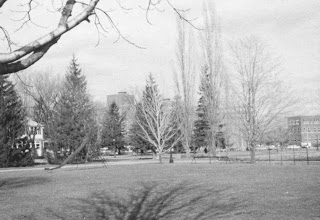
The Hill


When I was a kid there was a hill down the field from my house that just waited for winter. And every winter, as it had promised the spring before, a thick blanket of snow would return to provide the best sledding in the neighborhood. All the neighborhood kids made evening pilgrimages with their aluminum saucers to its summit, eager to fly off its snowy peak, down its deadly slopes and into hysterical, icy oblivion. Screaming and shouting, each of us would take turns down its steep banks, We'd re-emerge at its crest moments later, panting from the long return trip, and eagerly await our next flirtation with certain death. Snow suits and blue jeans heavy with snow, wet socks twisted tightly down around the toes of our ice-filled boots, and mittens long since lost, we'd joyfully weather the gray-skied hours, sledding and marching, sledding and marching, down and up the Hill late into the evening, when we’d hear the call and, exhausted, troop home to hot dinners and warm, dry clothes.

The Hill was marvelous to behold. Ancient and natural, bordered on one side by an abrupt and dense furrow of trees and brambles, on the other by a modest highway, and ending suddenly in a large cement ditch, its vast expanse was white and silent in winter, green and fragrant with penny royal in summer. Two steep, almost 90° banks joined by a slight decline of only five or six feet and followed immediately by a long, sloping grade prolonged an already exhilarating cruise into a trip to thrill any child. With its ponderous potential buried in its uneven slopes, the Hill was a favorite spot in summer too, when we’d roll down its golden banks of dandelions, howling dizzily as we staggered back up its sides to roll again. The most foolhardy among us would often run down, gaining momentum exponentially, cartoon-like legs whirling wildly beneath, until gravity and laughter would overcome him and he'd pitch forward with riotous delight. And in winter, as unwary spectators would drive by, we’d take shameless pleasure at reenacting with melodramatic anguish fatal injuries from our great gravity-defying saucer rides, only to run away laughing uproariously when someone would stop to offer aid. Yet, no bones were ever really broken; no noses bloodied. We must have been made of rubber.

The Hill had stood as I have described it for generations. A familiar landmark, it had been traveled up and down thousands of times by everyone in town going to and from work, visiting the neighboring town, heading to the village for a movie or dinner out. And everyone had special memories, though granted not all of them necessarily pleasant ones, of the Hill. You see, the Hill it seemed was not particularly fond of mechanical apparatus and was especially hostile to bicycles and their riders, both in the perilously swift ride down and the painfully arduous push back up. Nor was its icy winter road inviting to vehicles. Many a night I'd sit in my bedroom and hear tires spinning on the ice, as Beetle and snowplow alike were indifferently dispatched into one of its alpine banks. It even inflicted a mortal wound on my own Radio Flyer one summer when, thinking to re-enact the exhilarating flights of winter, I foolishly rode the luckless wagon pell-mell down the Hill, teeth rattling dangerously in my ten year old head, certain as I lurched down its side that death was only seconds away. I survived with only superficial injuries (and a very sore tailbone), but the wagon’s front tires would forevermore be splayed.

It was this animosity, then, this malevolent attitude towards things mechanical, that was finally, and sadly, the Hill's undoing.

I should explain that the Hill was one of the boundaries of the State Hospital where my father (where just about everybody's father) worked, and where, for almost 30 years, I called home. My family lived on the grounds, as many staff families did, and so for many of us the Hill was a twice daily experience at least. Whether walking, riding, driving, skiing, sledding, bicycling, rolling or running, one couldn’t go down to town or school nor get back home again without going down and up the Hill. And, because it was, in effect, the main entrance to the State Hospital, it was groomed and trimmed and meticulously cared for to reflect the importance it held as the pinnacle of the institution. Its steepness, Freud might have argued had he visited, was no mere accident, but a testimony to the rigorous and often arduous journey on which one must embark to regain the level footing of sanity. But that's another story.

In summer at least, the Hill had to be mowed. For all its beauty and majesty and potential, it was, after all, only a large, albeit very large, clump of dirt, rock and grass. And since, except to the children and a few adults, there was nothing magical about the Hill -- it had no supernatural grass that would grow only 2 inches and no longer -- that meant someone, or in this case several someones, had to mow it. And quite a job it was.

Once upon a time, patients would mow the grounds. They would be sent out in crews, the sane and the not-so-sane, with simple rotary mowers, to tame the acres and acres of lawns that made up the Hospital grounds. Teams of men, all dressed in hospital drab, would patiently mow -- around trees, up steep banks and down, over hidden woodchuck holes, under immense pines. The whirling blades of their simple machines would mingle with the sounds of summer, and the moist, fresh smell of new-mown grass would drench the air. There was satisfaction in this simple task, and the Hill showed no animosity towards either men or machines as they made their way, week after week, summer after summer, across its green terraces and down its high banks. These men were much like us children -- moving across the Hill with ease, tracing patterns as they went.

And so the Hill stood for all the seasons of my childhood -- noisy children and quiet men crisscrossing its angular sides, defying gravity or surrendering to it through the years.

But slowly technology ascended. Time passed and the crews of quiet men and simple machines were replaced by loud, intrusive tractors pulling long blade assemblies, piloted by solitary men who seemed to find little pleasure in their task. Isolated from the fragrant expanse and aloof atop their fuming machines, they rumbled vacantly across the turf. Yet, while making short work of most of the grounds, these men and machines would struggle against the Hill, often leaning precariously over an edge or sometimes running wildly down a slope, digging huge earthy scars in the luxuriant green hillside, scars that remained like exposed gashes in its sides. Woodchuck holes would routinely grab wheels, leaving disabled machines abandoned for hours or days awaiting rescue, and there would often be patches here and there of tall weeds, too difficult to reach with the massive machines, emblems of neglect and indifference dotting the hillside.

No longer beautiful, the Hill looked wounded and forgotten. By now, we had all grown and left and no children remained to follow us. Patients, thanks to medications and a new philosophy, were no longer encouraged to participate in their environment and many instead spent their days sleeping on benches or wandering the grounds with little of value to do. The Hill, once immense and inspiring, was now merely a nuisance to mow.

When I returned home, after many years' absence, I was saddened but not surprised to see that the face of the Hill had been changed. Regrettably, the two steep banks had been leveled. In their place was a single, unremarkable grade. Tamed by idle minds with little spirit and less imagination, it had been stripped of its uniqueness.

Certainly over the years there was no lack of willing manpower to mow the Hill. It gave summer days a purpose to those who might otherwise have had none. And in winter it was a treasured playmate for generations of children. To the children of subsequent generations it is now merely a hill, just one more common, unremarkable thing in their lives.

If I believed in omens I might be inclined to say the leveling of the Hill was a sign of things to come. Now no longer a State Hospital, the grounds and buildings have been surrendered to house prisoners, none of whom enjoy the freedom to stroll through and enjoy the grounds and woods that surround them. Once an environment of rehabilitation, now the grounds, where not barricaded with razor-like barbed wire, go largely ignored or unused, fenced or paved over. Natural beauty has been displaced by base technological ugliness, designed as much it seems to keep the restorative environment out as to keep dangerous criminals in. It makes me question why such a place would be sacrificed for those who cannot be permitted to benefit from it.

The Hill as I knew it is gone, and so are the times in which it stood. What now survives is a sadly familiar hallmark of man's willingness to compromise nature for convenience. Leveled to make life easy for someone, the hill no longer stands as the summit of a beneficent institution but represents instead cheerless compromise and acquiescence. It sits sadly lifeless, its distant images of children tumbling and men moving gracefully across the fragrant grasses of summer slowly fading away.

© by Erich Trapp
1996